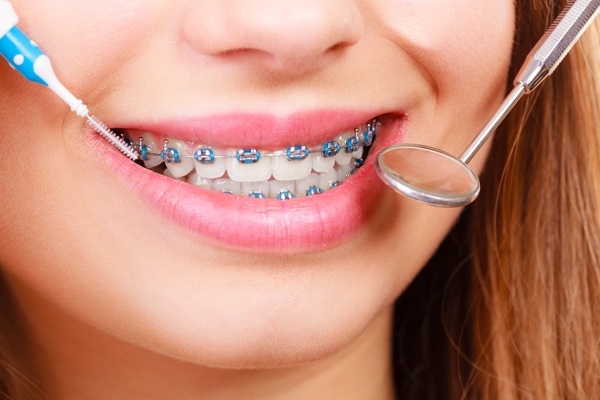
Dental braces are one of the most common orthodontic treatments used to correct misaligned teeth. They improve both your oral function and appearance. With advancements in orthodontics, patients now have access to a range of options tailored to individual needs.
Traditional metal braces
Traditional metal braces are the most commonly used type of orthodontic treatment and have been the standard solution for decades. They consist of metal brackets bonded to the teeth and connected with wires and elastic bands (ligatures). These braces gradually shift the teeth into their desired alignment by applying controlled pressure.
Although metal braces are noticeable, they are highly effective for moderate to severe cases of overcrowding, spacing, and bite irregularities. Additionally, modern designs are smaller and more comfortable than earlier versions. The patient also has more options to add colored elastic bands to the braces for a more personalized style.
Clear or ceramic Braces
Clear or ceramic braces provide a more discreet option compared to traditional metal braces. They are made from tooth-colored or clear materials, blending in more naturally with the patient's teeth and reducing their visibility in social situations. Orthodontists often recommend ceramic braces for older teenagers and adults seeking effective orthodontic treatment without a metallic appearance.
Ceramic braces function similarly to traditional metal braces. However, they require careful maintenance and oral hygiene to prevent staining the brackets. They are also larger and more fragile than metal braces.
Lingual braces
Lingual braces are placed on the inner surfaces of the teeth, making them invisible to other people. They work in the same way as traditional braces but remain hidden behind the teeth. This option is particularly appealing to individuals concerned about their appearance during treatment.
However, lingual braces may initially cause some discomfort to the tongue and require time for adjustment. They are most effective for patients with specific bite or alignment problems that can be corrected with customized appliances. The orthodontist makes each set of lingual braces to match each patient's needs and the unique contours of their teeth.
Self-litigating braces
Self-ligating braces are similar to traditional metal braces. However, their main distinction is that they do not use elastic bands. Instead, they use a built-in clip system to hold the archwire in place. They can work with ceramic, traditional metal, or clear brackets.
Since they do not use elastic bands that need to be replaced, the clip requires fewer adjustments, and less pressure is applied to the tooth. Self-litigating braces are ideal for patients whose teeth are more sensitive, who cannot sit in the orthodontist chair for a long time, or who have higher orthodontic needs and developmental delays.
Clear aligners
Clear aligners represent one of the most modern alternatives to traditional dental braces. These removable trays are custom-made to gradually shift the patient's teeth into the desired position. Aligners are nearly invisible, allowing for easier cleaning and eating since the patient can remove them.
Clear aligners are best suited for mild to moderate alignment concerns. That said, patients need to be consistent about wearing their aligners to achieve their desired results within the planned treatment time. The average treatment time for clear aligners is 18 months, but it can be shorter or longer depending on the patient's needs.
Schedule a consultation at our Pinehurst office
Dental braces offer solutions to improve both dental health and appearance. Our orthodontic team tailors treatments to our patients' needs to address functional issues and improve their long-term health. Would you like to learn more about the dental braces we offer? Schedule a consultation at our Pinehurst office to get started.
Request an appointment here: https://www.orthoisfun.com or call Henry Orthodontics at (910) 685-7395 for an appointment in our Pinehurst office.
Check out what others are saying about our services on Yelp: Dental Braces in Pinehurst, NC.
Related Posts
Clear braces offer a more discreet way to straighten teeth while still delivering the consistent control of bracket-and-wire orthodontics. Many patients like that the brackets blend into the smile, which can feel more comfortable for photos, school, and professional settings. Even with a subtle look, treatment still follows a detailed plan to improve alignment and bite…
Are you considering your teeth straightening options? Read on to learn more. Imperfect teeth can lower self-esteem and prevent people from smiling naturally. With all the advances in orthodontics, there are more options for getting straighter, healthier teeth. Getting a teeth straightening procedure is well known for cosmetic reasons, but its health benefits are noteworthy…
Have you been looking into braces treatment to achieve a more aligned smile? A braces specialist is an orthodontic professional with specialized expertise that leads to a more comfortable and efficient orthodontic experience. Working with a braces specialist gives you access to advanced skills, personalized treatment plans, and modern technology for better comfort and oral…
When someone searches the phrase "Invisalign® near me," they often want a nearly invisible option to straighten their teeth, but there is more at stake than just alignment. A well-aligned smile can impact how others perceive professionalism, trustworthiness, and social ease. In many careers, first impressions and clear communication carry weight, and a straight smile…